What's new in version 6.40 (March 2025)
We recommend that you carefully review this information for any possible impacts to workflows and take appropriate action to avoid disruptions.
CAUTION – All data files in the receiver are deleted when you install new firmware. Before you start, ensure that you first download any data files from your receiver to your computer.
For information about software compatibility, see Supported software.
Main changes and improvements
IonoGuard.
To configure IonoGuard, see general receiver settings.
QZSS L6.
NOTE – QZSS CLAS is supported. QZSS CLAS provides centimeter-level nationwide positioning PPP-RTK correction service for Japan. Compact SSR correction format broadcast at 2,000 bps on the QZSS L6D signal. QZSS CLAS supports multi-GNSS including GPS, Galileo, and QZSS. Use firmware version 6.26 or later and enable QZSS L6D on the Tracking screen.
|
QZSS CLAS |
Static (95%) |
Kinematic (95%) |
|---|---|---|
|
Horizontal accuracy |
≤ 6 cm |
≤ 12 cm |
|
Vertical accuracy |
≤ 12 cm |
≤ 24 cm |
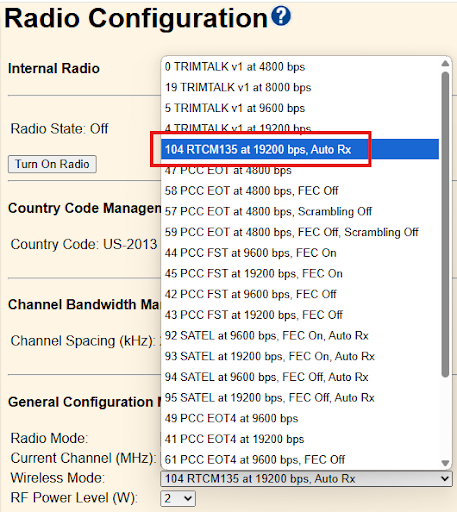
RTCM 135 UHF protocol. (R780 only). Added RTCM 135 UHF protocol radio support for 450 MHz radios for receive-only radio frequencies. Improving base/rover interoperability on construction sites with a mixed fleet and any capable RTK base station is the motivation behind supporting this new radio protocol.
Support for the new RTCM135 UHF protocol for 450 MHz radios has been implemented for the following GNSS receiver and operating modes:
-
R780: Rx, Tx (except EU/ROW 25 kHz channel spacing)
To configure the radio, select Radio / Radio Configuration.
VRS.
General improvements and fixes
NMEA GGA output.
Radio LED.
Radio mode. (R780 only) Repeater options added back to the Radio Mode list. See Radio Configuration.
Jamming and spoofing – general improvements
-
Prevent receiver reboots during rare spoofing events.
-
Prevent large position jumps during spoofing events, which are especially common after jamming periods.
-
Improvements to B1 tracking when B2A/B2B is jammed.
-
Improved BeiDou ephemeris handling for Trimble RTX® when signals are jammed.
Jamming and spoofing – navigation message authentication
-
Added support for Galileo OSNMA
-
OSNMA safeguards receivers by verifying the authenticity of Galileo navigation data, effectively mitigating data-level spoofing threats and bolstering overall system security.
-
-
Added support for Trimble ProPoint® RTX-NMA
-
Trimble ProPoint RTX-NMA provides broadcast ephemeris authentication via the Trimble RTX correction stream in real time with initial support for GPS and BeiDou-3 satellites.
-
A Trimble RTX subscription is not required.
-
ProPoint RTX-NMA complements Galileo OSNMA.
-
ProPoint RTX-NMA protects the user PVT solution from:
-
faulty demodulated navigation messages with passed parity check.
-
fake navigation messages produced by nearby GNSS spoofers.
-
-
