Targets
Paper targets
-
Checkerboard pattern, not shiny or reflecting.
-
It is recommended to print the dark gray squares on white paper with a laser printer. The targets should be laminated using dulled sleeves for best results. The printed target should be tested for using in the field. Trimble does not guarantee success with printed targets.
-
Good recognizable labeling with consecutive numbering for referencing the total station data.
-
Affix printed targets with non-reflective adhesive tape.
-
Distribute the targets over the scanning area at different elevations.
-
The minimum number of targets is three per scan, recommended are five to six.
Affix the targets only on flat surfaces. Make sure targets are not bent anyhow. Round columns or pipes are not recommended and will increase the error of the target fitting enormously.
The paper target should be mounted vertically aligned. This is important for detecting the target center accurately.
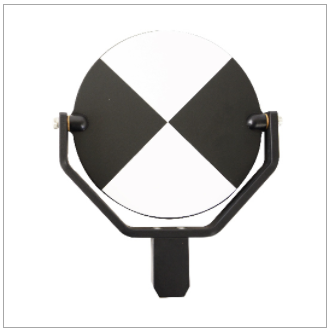
Adjustable black and white tilting targets
-
Adjustable 6” (152 mm) black and white tilting target, for affixing to pole top and used in multiple survey jobs.
-
Contrasting 6″ (152mm) black and white pattern
-
Matte non-glare target material
-
Adjustable tilting axis
-
Since the target center is tilt-able, it can be measured perfectly with the scanner as well as with the total station. Before starting a scan, always orientate the tilting target towards the scanner / total station.
-
Attach the target via a standard aligning adapter.
-
Distribute the targets over the scanning area at different elevations.
-
The minimum number of targets is three per scan, recommended are five to six.
Adhesive black and white checker targets
-
Checkerboard pattern, not shiny or reflecting.
-
Adhesive targets are easier to affix because no tape is required.
-
Distribute the targets over the scanning area at different elevations.
-
The minimum number of targets is three per scan, recommended are five to six.
Spheres
Spheres can be acquired more accurately than flat black and white checkerboard targets and from any direction without consideration of angle of incidence. Spheres aren't as practical to use when a high number of targets are required. They also require a prism or flat target to be positioned at the same height in order to survey their location with a total station.
-
100 mm and 230 mm non reflective.
-
Distribute the spheres over the scanning area at different elevations.
-
The minimum number of spheres is 3 per scan, recommended are 5 to 6.
