Safety information
Before you use your Trimble product, make sure that you have read the user manual and understood all safety requirements. Failure to follow the instructions, warnings and precautions may lead to device damage, and/or user injury.
Indicates an imminently hazardous situation which, if not avoided, might result in death or serious injury.
This alert warns of a potential hazard which, if not avoided, could result in severe injury or even death.
This alert warns of a potential hazard or unsafe practice that could result in minor injury or property damage or irretrievable data loss.
An absence of specific alerts does not mean that there are no safety risks involved.
Use and care
Also see Transport and maintenance.
Operating or storing the instrument outside the specified temperature range can damage it.
Please read carefully the manual before using the instrument. Failure to follow the instructions, warnings and precautions that are in the manual may lead to device damage, and/or user injury.
Permitted use
-
Collecting 3D scans and images.
-
Data processing by means of field and office software.
Adverse use
-
Use of the product without instruction.
-
Use outside of the intended limits.
-
Disabling safety systems.
-
Removal of hazard notices.
-
Opening the product using tools, for example, a screwdriver, unless this is specifically permitted for certain functions.
-
Modification or conversion of the product.
-
Use after misappropriation.
-
Use of products with obviously recognizable damage or defects.
-
Use with accessories from other manufacturers without the prior explicit approval of Trimble.
-
Inadequate safeguards at the surveying site, for example when measuring on roads.
-
Controlling of machines, moving objects or similar monitoring applications without additional control and safety installations.
Adverse use can lead to injury, malfunction and damage. It is the task of the person responsible for the equipment to inform the user about hazards and how to counteract them. The product is not to be operated until the user has been instructed on how to work with it.
Limits of use
Suitable for use in an atmosphere appropriate for permanent human habitation; not suitable for use in aggressive or explosive environments.
Local safety authorities and safety experts must be contacted before working in hazardous areas, or in close proximity to electrical installations or similar situations by the person in charge of the product.
Responsibilities
Suppliers
Trimble is responsible for supplying the product and original accessories in a completely safe condition and providing instruction for safe operation.
Manufacturers of other accessories are responsible for developing, implementing and communicating safety concerns for their products when used in combination with the Trimble product.
Owners and operators
Owners and operators have the following responsibilities:
-
Understand the safety instructions on the product and in the user manual.
-
Ensure personnel who use the product are trained to safely use the equipment in accordance with the instructions.
-
Be familiar with local regulations for safety and accident prevention.
-
Inform Trimble immediately if the product becomes unsafe for any application.
Hazards of use

-
By working during a thunderstorm you are at risk from lightning.
- Do not carry out field surveys during thunderstorms.
Because of the risk of electrocution, it is very dangerous to use poles and extensions in the vicinity of electrical installations such as power cables or electrical railways.
- Keep at a safe distance from electrical installations. If it is essential to work in this environment, first contact the safety authorities responsible for the electrical installations and follow their instructions.

If the battery breaks, contact with the corrosive gel is possible!
During the operation of the product, extremities hair and/or clothing can get caught in rotating parts.
-
Keep a safe distance to the rotating parts.
The absence of instruction or training can lead to incorrect or adverse use of the product and lead to accidents with far reaching human, material, financial and environmental consequences.
-
All users must follow the safety instructions provided in the manual.
Inadequately securing of the working site can lead to dangerous situations, for example with road traffic or building and industrial construction sites.
-
Always ensure that the working site is adequately secured. Adhere to the regulations governing safety and accident prevention.
If the accessories used with the product are not properly secured and the product is subjected to mechanical shock, for example blows or falling, the product may be damaged or people may sustain injury.
-
When setting up the product, make sure that the accessories, for example tripod, tribrach, connecting cables, are correctly adapted, fitted, secured, and locked in position. Avoid subjecting the product to mechanical stress.
During transport, shipment or disposal of batteries, the battery pack can be subject to unintended, mechanical stress which might lead to fire hazards.
-
During transport and shipment, users should abide by national and international regulations. Contact local authorities prior to transport or shipment.
-
Properly dispose of used batteries.
Charging with a device other than the charger provided by Trimble, could destroy the batteries. Fire and explosions can occur.
High mechanical stress, high ambient temperatures or immersion into fluids can cause battery leakage, fire or explosion.
-
Protect the batteries from mechanical influences and high ambient temperatures. Do not drop or immerse batteries into fluids.
If the product is improperly disposed of, the following can happen:
-
If polymer parts are burnt, poisonous gasses are produced which may impair health.
-
If batteries are damaged or are heated strongly, they can explode and cause poisoning, burning, corrosion or environmental contamination.
-
By disposing of the product irresponsibly you may enable unauthorized persons to use it in contravention of the regulations, exposing themselves and third parties to the risk of severe injury and rendering the environment liable to contamination.
-
The product must not be disposed of with household waste. Dispose of the product appropriately in accordance with the national regulations in force in your country. Always prevent access to the product by unauthorized personnel.
If computers intended for use indoors are used in the field there is a danger of electric shock.
-
Adhere to the instructions given by the computer manufacturer with regard to field use in conjunction with Trimble products.
Watch out for erroneous measurement results if the product has been dropped or has been misused, modified, stored for long periods or if damage is observed after transport.
-
If any abnormal instrument behavior or results are detected please contact your dealer to arrange a system check.
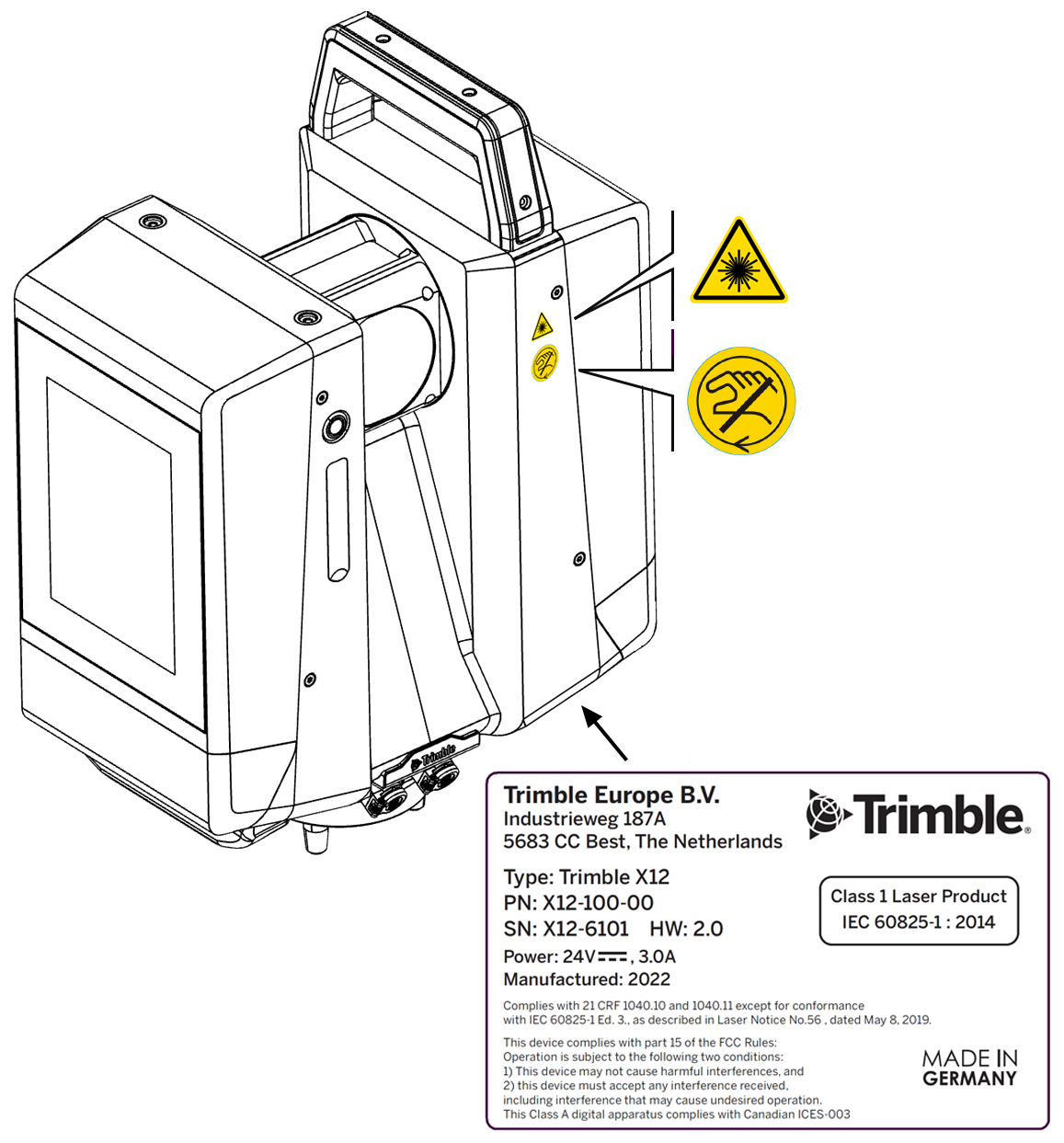
Laser safety
Before you use the instrument, make sure that you understand this user guide, as well as all equipment, job site safety requirements and regulations.
This equipment has been tested and found to comply with IEC 60825-1 2007, IEC 60825-1 2014, and 21 CFR 1040.10, and 1040.11 except for deviations pursuant to Laser Laser Notice No. 56, dated May 18, 2019.
Use of controls or adjustments or performance of procedures other than those specified herein may result in hazardous LED or laser radiation exposure. As with any bright light source, such as the sun, electric welding arcs or arc lamps, common sense applies. For further information regarding safe use of lasers, refer to the IEC 60825-1 2007, and IEC 60825-1 2014.
Laser safety classification
The scanner is a class 1 laser product that has been tested and found to comply with IEC 60825-1 2007, IEC 60825-1 2014, and 21 CFR 1040.10, and 1040.11.
-
Laser wavelength: 1500 nm, invisible
-
Beam diameter/divergence: ~ 3.5 mm @ 1 m/~ 0.3 mrad (1/e2, half angle)
Battery safety
Do not damage the rechargeable Lithium-ion battery. A damaged battery can cause an explosion or fire, and can result in personal injury and/or property damage. To prevent injury or damage:
-
Do not use or charge the battery if it appears to be damaged. Signs of damage include, but are not limited to, discoloration, warping, and leaking battery fluid.
-
Do not expose the battery to fire, high temperature, or direct sunlight.
-
Do not immerse the battery in water.
-
Do not use or store the battery inside a vehicle during hot weather.
-
Do not drop or puncture the battery.
-
Do not open the battery or short-circuit its contacts.
Avoid contact with the rechargeable Lithium-ion battery if it appears to be leaking. Battery fluid is corrosive, and contact with it can result in personal injury and/or property damage. To prevent injury or damage:
-
If the battery leaks, avoid contact with the battery fluid.
-
If battery fluid gets into your eyes, immediately rinse your eyes with clean water and seek medical attention. Do not rub your eyes!
-
If battery fluid gets onto your skin or clothing, immediately use clean water to wash off the battery fluid.
Charge and use the rechargeable Lithium-ion battery only in strict accordance with the instructions. Charging or using the battery in unauthorized equipment can cause an explosion or fire, and can result in personal injury and/or equipment damage. To prevent injury or damage:
-
Do not charge or use the battery if it appears to be damaged or leaking.
-
Charge the battery only in a Trimble product that is specified to charge it.
-
Be sure to follow all instructions that are provided with the battery charger.
-
Discontinue charging a battery that gives off extreme heat or a burning odor.
-
Use the battery only in Trimble equipment that is specified to use it.
-
Use the battery only for its intended use and according to the instructions in the product documentation.
-
Cover battery terminals with proper insulating tape before disposal to avoid heat generation by an inadvertent short-circuit.
Electromagnetic Compatibility EMC
The term Electromagnetic Compatibility describes the capability of the product to function smoothly in an environment where electromagnetic radiation and electrostatic discharges are present, without causing electromagnetic disturbances to other equipment.
Electromagnetic radiation can cause disturbances in other equipment.
-
Although the product meets the strict regulations and standards which are in force in this respect, Trimble cannot completely exclude the possibility that other equipment may be disturbed.
There is a risk that disturbances may be caused in other equipment if the product is used in conjunction with accessories from other manufacturers, for example field computers, personal computers, two-way radios, non-standard cables or external batteries.
-
Use only the equipment and accessories recommended by Trimble. When combined with the product, they meet the strict requirements stipulated by the guidelines and standards. When using computers and two-way radios, pay attention to the information about electromagnetic compatibility provided by the manufacturer
If the product is operated with connecting cables attached at only one of their two ends, for example external supply cables, interface cables, the permitted level of electromagnetic radiation may be exceeded and the correct functioning of other products may be impaired.
-
While the product is in use, connecting cables, for example product to external battery, product to computer, must be connected at both ends.
Disturbances caused by electromagnetic radiation can result in erroneous measurements. Although the product meets the strict regulations and standards which are in force in this respect, Trimble cannot completely exclude the possibility that the product may be disturbed by very intense electromagnetic radiation, for example, near radio transmitters, twoway radios or diesel generators.
-
Check the plausibility of results obtained under these conditions.
FCC statement, applicable in the U.S.
This equipment has been tested and found to comply with the limits for a Class A digital device, pursuant to part 15 of the FCC rules.
These limits are designed to provide reasonable protection against harmful interference in a residential installation.
This equipment generates, uses and can radiate radio frequency energy and, if not installed and used in accordance with the instructions, may cause harmful interference to radio communications. However, there is no guarantee that interference will not occur in a particular installation.
If this equipment does cause harmful interference to radio or television reception, which can be determined by turning the equipment off and on, the user is encouraged to try to correct the interference by one or more of the following measures:
-
Reorient or relocate the receiving antenna.
-
Increase the separation between the equipment and the receiver.
-
Connect the equipment to an outlet on a circuit different from that to which the receiver is connected.
-
Consult the dealer or an experienced radio/TV technician for help.
Changes or modifications not expressly approved by Trimble for compliance could void the users authority to operate the equipment.
FOR PORTABLE DEVICE USAGE (<20 cm from body / SAR needed)
Radiation Exposure Statement: This device meets the government’s requirements for exposure to radio waves. This device is designed and manufactured not to exceed the emission limits for exposure to radio frequency (RF) energy set by the FederalCommunications Commission of the U.S. Government.
The exposure standard for wireless devices employs a unit of measurement known as the Specific Absorption Rate, or SAR. The SAR limit set by the FCC is 1.6W/kg. *Tests for SAR are conducted using standard operating positions accepted by the FCC with the device transmitting at its highest certified power level in all tested frequency bands.
